


Home / Video / / Sculptures / Curatorial Projects / Bio / Contact
| Schrebergärten Make dreams come true Homes I Models |
Homes II Demo Derby Philippe Pedrogulho |
Martha Portraits/Interiors College Berlin |
Matriarchy Los Machos Wild Paradise Homes III |
||
|
|||||
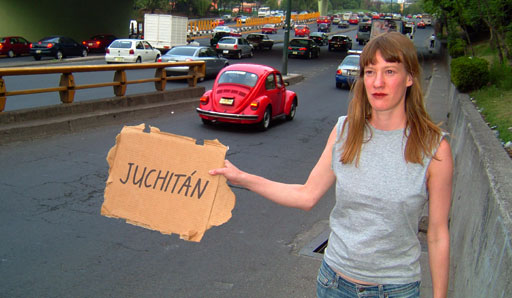
Juchitán (Mexico City, May 9 2005) C print 6,4 x 11 inches (2005)
"Juchitán" documents my attempt to escape from Mexico City to Juchitán, a cosmopolitan city famous
for its indigenous society deeply rooted in its arts and culture, a social and economic system based on
a form of "matriarchy" (the women own homes and businesses, men do work in the fields and hold
important political positions), progressive politics and a history of resistance against oppressive and
colonialist powers (from the Aztecs, to the Spanish and French); It was the first town to challenge
Mexico’s dominant political party, the PRI, and became Mexico's first autonomous municipality.
"What animates struggles for social justice and makes democratization possible? The southern Mexican
city
of Juchitán offers the paradoxical lesson that difference and disruption can foster the establishment of
multifaceted
democracy. Democracy occurred in Juchitán not because Western cultural and economic
practices proceeded apace there, but
because the outside was kept out in significant ways in the twentieth
century and Zapotec Indians mobilized politically at the
borders of violence.
A Zapotec political movement, the Coalition of Workers, Peasants, and Students of the Isthmus, or COCEI,
has governed Juchitán
since 1989. COCEI administers social welfare funds for the city of 100,000 with widely
acknowledged efficiency, promotes Zapotec
language and culture, and mobilizes poor people around pressing
economic issues. COCEI secured this right to govern through
fifteen years of militant grassroots activism
that combined direct action mobilizations with electoral participation. As a
result of its opposition to the
Mexican regime, COCEI faced brutal killings and military occupation. Since 1989, in contrast,
Mexican
authorities have respected the results of elections in Juchitán, invested in municipal services, and curbed
human rights abuses, outcomes that are particularly noteworthy in light of decades of polarized conflict in
nearby Chiapas and
Central America." (Jeffrey W. Rubin)