


Home / Video / / Sculptures / Curatorial Projects / Bio / Contact
first picture < previous next > last picture
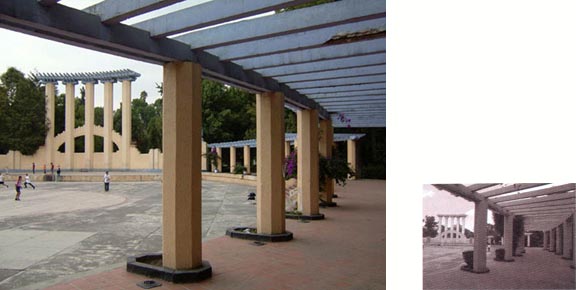
PARQUE MEXICO, Enrique Aragón Echegaray, 1927-1938
Arquitectura Contemporánea (with Christoph Draeger)
synchronized slide installation with two projectors and audio, 84 slides, 18 min, 2005/2014
Starting point of the project was the architectural guidebook Guía
de arquitectura contemporánea de la Ciudad de México (Banamex, 1993) which spans 20th
century architecture in Mexico City. Our aim was to do a remake of the guide: to visit each of the 165 buildings and to reconstruct the viewpoint and angle of each photograph in the book as closely as possible. Contrary to the stark black and white photography of the originals printed in the guide book which were mostly photographed soon after
the completion of the buildings with professional cameras using angle corrections, our photographs were taken with a small consumer type digital camera, in color. (We used photoshop to correct angles.)
The piece takes the format of a lecture about 20th century architecture of Mexico City: two slide projections juxtapose b&w images from the guide book with our color photographs taken in 2005. This offers an immediate comparison between the state of the buildings shortly after their completion (in an “ideal” or “pure” state of the architecture) and their appearance in 2005. In the audio voice-over we talk about the architectural qualities of the buildings, sometimes quoting the texts from the original guide book. We comment on the changes in their appearance, the aging of the buildings and their surroundings, the history of the buildings, including social and political references. And we recount anecdotes of episodes while taking the pictures... The piece critically reflects on the changes in Mexcio City’s cityscape, the shortfalls of architectural guidebooks and, more generally the relationship between architecture and photography.
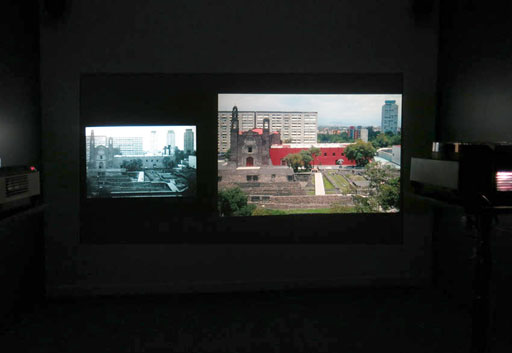
installation view Tamayo Museum, Mexico City, 2014